I have an Atari vector Space Duel cab and a couple of spare PCBs.
I've fancied a Gravitar for a while, but they're not that common and even finding a Gravitar PCB and making an adapter to plug into the Space Duel cab is not that easy either.
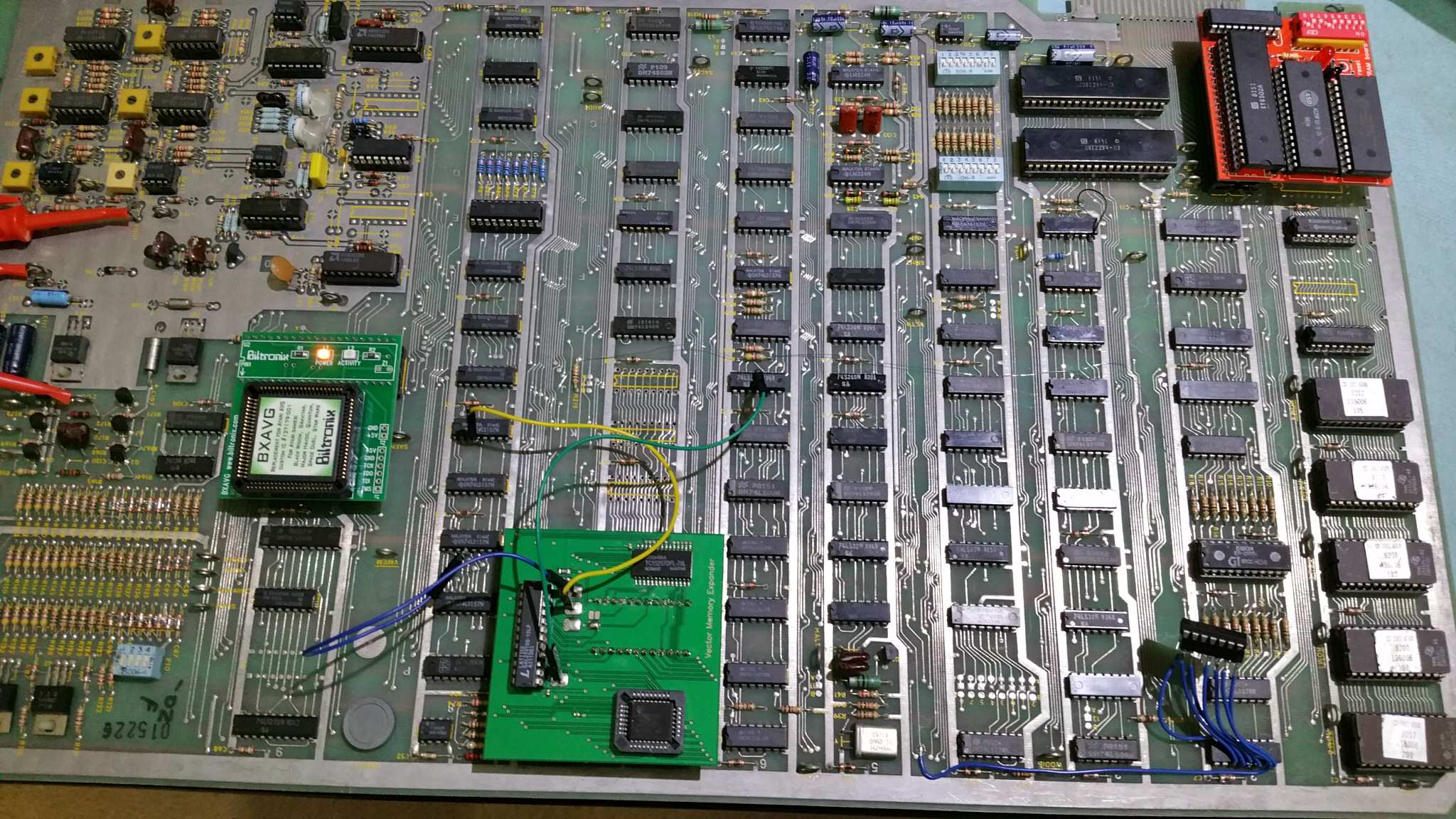
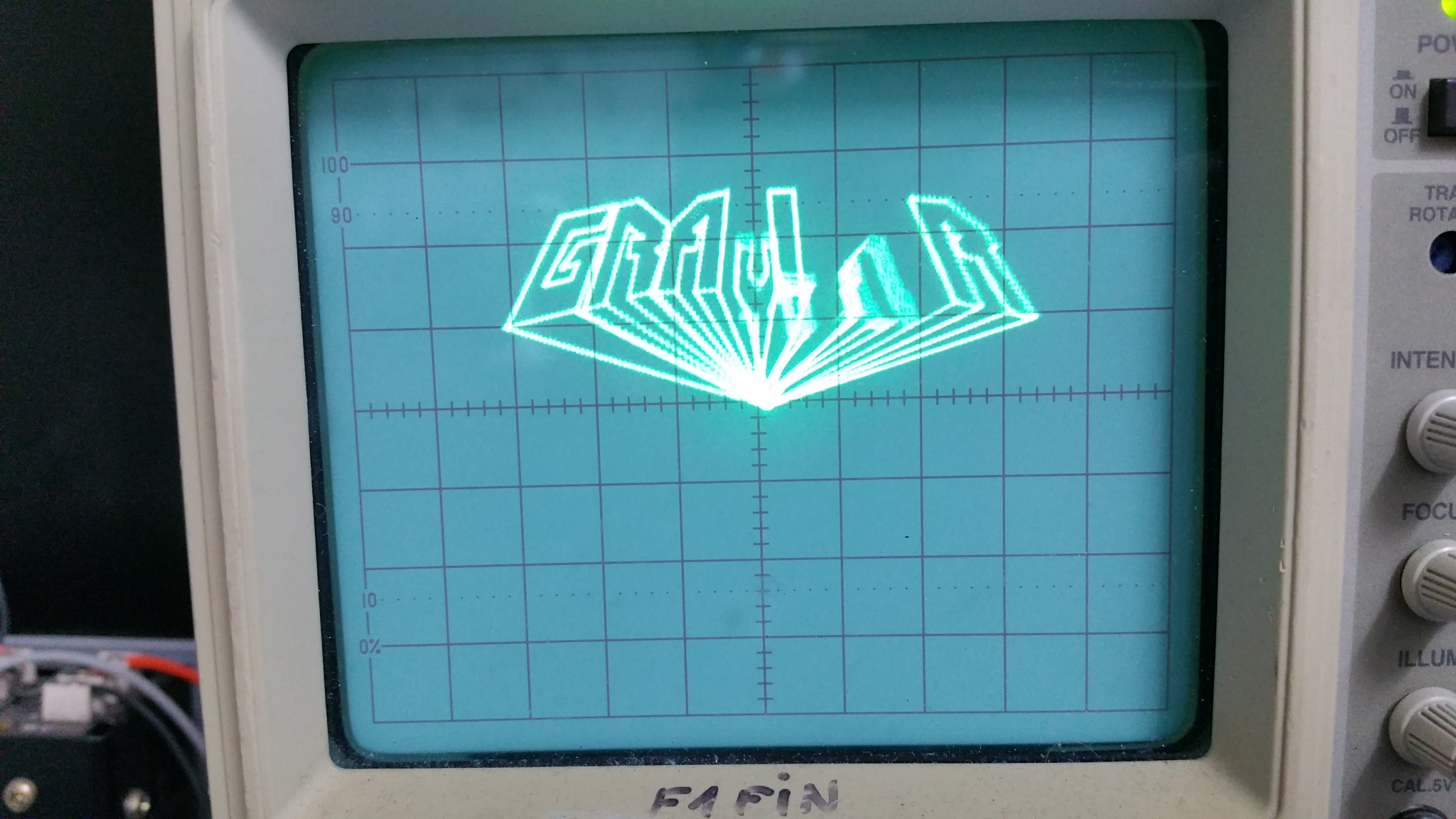
How about running Gravitar on a Space Duel PCB itself then? The Gravitar PCB looks pretty similar to a Space Duel PCB, just a few more EPROMs for more memory space for extra code and graphics. It's obvious that Gravitar is an evolution of Space Duel hardware.
Surely if I just fix some Gravitar EPROMs to the Space Duel PCB with electrical tape that would do it, wouldn't it? Won't the software code diffuse down into the PCB tracks and all just work?

Unfortunately it looks like it might be a **bit** more complex than that. A good look at the schematics for both Space Duel and Gravitar show a great deal of similarities, even a lot of the chips are in the same PCB locations on the Gravitar as the Space Duel.
The main obvious difference is the larger ROM space for both CPU program ROM and vector ROM. 24K rather than 18K for CPU ROM, and 14K instead of 6K for vector ROM. Gravitar has twice as much CPU RAM with 2K instead of 1K, and it has a bank switched area similar to Asteroids, and I guess this is for the same reason to switch banks for 2 player games and keep the software routines simpler.
Another difference is that Gravitar has analogue vector scaling, which is used to scale or 'zoom' vector out to smaller sizes smoothly. Space Duel only has digital scaling in steps of powers of 2, although the older Tempest and Battlezone do have this analogue scaling too.
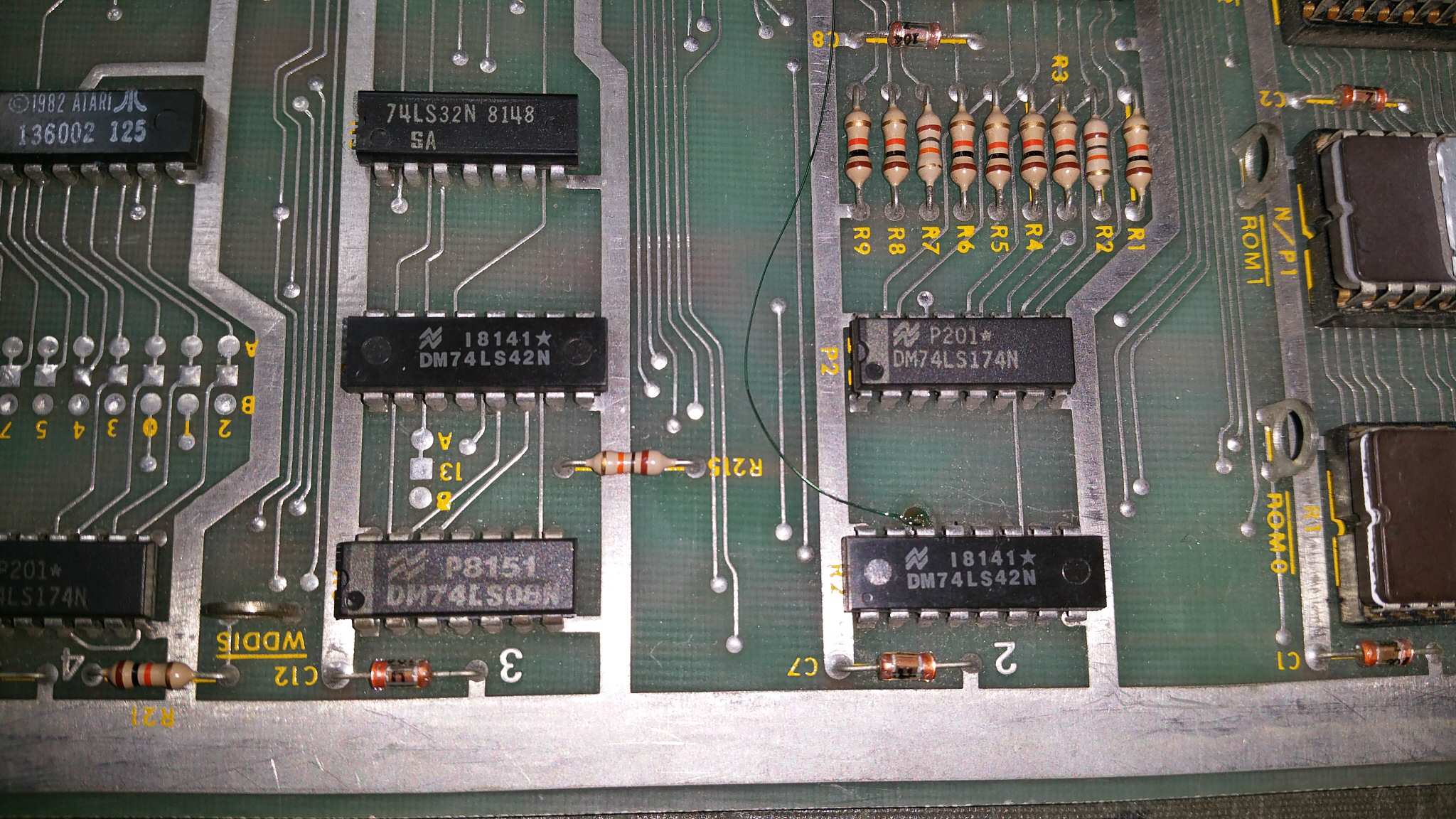
This analogue scaling circuitry is what actually started me on this quest, I spotted that there are some empty chip locations (E8 and D9) on a Space Duel PCB that are NOT shown on the schematics, but match exactly the scaling DAC and latch that is used on Gravitar.

Mitchell Gant2016-02-09 22:33:08
I've fancied a Gravitar for a while, but they're not that common and even finding a Gravitar PCB and making an adapter to plug into the Space Duel cab is not that easy either.
How about running Gravitar on a Space Duel PCB itself then? The Gravitar PCB looks pretty similar to a Space Duel PCB, just a few more EPROMs for more memory space for extra code and graphics. It's obvious that Gravitar is an evolution of Space Duel hardware.
Surely if I just fix some Gravitar EPROMs to the Space Duel PCB with electrical tape that would do it, wouldn't it? Won't the software code diffuse down into the PCB tracks and all just work?
Unfortunately it looks like it might be a **bit** more complex than that. A good look at the schematics for both Space Duel and Gravitar show a great deal of similarities, even a lot of the chips are in the same PCB locations on the Gravitar as the Space Duel.
The main obvious difference is the larger ROM space for both CPU program ROM and vector ROM. 24K rather than 18K for CPU ROM, and 14K instead of 6K for vector ROM. Gravitar has twice as much CPU RAM with 2K instead of 1K, and it has a bank switched area similar to Asteroids, and I guess this is for the same reason to switch banks for 2 player games and keep the software routines simpler.
Another difference is that Gravitar has analogue vector scaling, which is used to scale or 'zoom' vector out to smaller sizes smoothly. Space Duel only has digital scaling in steps of powers of 2, although the older Tempest and Battlezone do have this analogue scaling too.
This analogue scaling circuitry is what actually started me on this quest, I spotted that there are some empty chip locations (E8 and D9) on a Space Duel PCB that are NOT shown on the schematics, but match exactly the scaling DAC and latch that is used on Gravitar.
Mitchell Gant2016-02-09 22:33:08