US AAF Mustang (Bootleg)

Jacmar

Active member
Feedback
1 (100%)
Credits
528CR
TAB Austria Bootleg Version.

IMG_3830.JPG

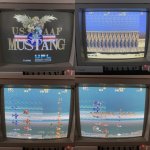
Removed the soldered wires from the edge connector and booted up... Looked good to begin with as title screen popped up .. but quickly realised all was not well as obvious missing or duplicated sprites and background graphics issues became apparent during attract mode ....
first boot.jpg

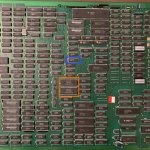
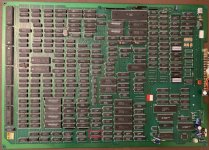
This is a big board and the chips seem really close together so visual check wasn't easy but I did find a few areas of concern .. Found a LS161 with a leg that hadn't made it through the board ! Pin 4 was bent right up and nearly touching the adjacent chip. This is really weird because it doesn't appear this chip has ever been changed, the solder on the back looks original suggesting it's been like this since it was manufactured. Checking the solder side traces, pins 3, 4, 5, 6 & 8 on this chip should all be connected.. but there was no continuity to pin 4.
Connected a quick bridging wire from pins 4 to 6 seemed to fix the corrupted sprites! Soldered up the pins (not very tidy I know) and all seems to be well regarding sprites now.(y)

dodgy 161.jpg

Seems crazy that the game could have been broken all it's life but the way that leg appears never to have gone through the pcb certainly suggests it :oops:

fixed 161.jpg

I did also find a LS74 with a chopped pin 8 ... re-instated that but it added interference to the screen / graphics so I unsoldered and separated that connection again as that appears to have been done on purpose to improve the picture. Can't see any other damage to the board so will probe around and see if I can find the issue causing the dodgy background layer ..... tbc
 

Jacmar

Active member
Feedback
1 (100%)
Credits
528CR
Just checked my voltages and had 4.00 volts on the board. Cranked my PSU to 6.00 volts and now got 4.5 volts on the board. Hasn't made any difference, game was running fine at 4 volts :)... I played it to second level no problem, the background graphics problem is not that bad on level 1 !!
 

Jacmar

Active member
Feedback
1 (100%)
Credits
528CR
Quick update on this, after replacing a couple of TTL chips which had dodgy looking signals, replacing a crystal I broke a leg off by moving it too often to get access to a chip, and repairing a broken trace found under a chip that had been socketed and replaced by someone before me, still no change ... Also came across this which surprised me ... another example of a pin not ever seeming to have gone through the PCB , this time one of the 68000 CPU legs, pin 33 (A5) ..
IMG_4343.JPG

However there IS continuity through the via to the pad underneath. Then I found 2 of the CPU legs (pin 33 and I think it was pin 40) we're not connected to their corresponding resistors in the above resistor arrays. But I've connected them up and again no difference...
Have now also been over the whole board of TTL chips with the logic probe and SLICE and nothings standing out as obviously failed, so I think next steps will be to look at removing the MASK ROMS 7-10 which hold the background data, and the relevant RAMS and check those out ... just waiting for a better de-soldering setup to arrive before taking those on!
 

Jacmar

Active member
Feedback
1 (100%)
Credits
528CR
The key to the corrupt background layer was staring me in the face all along, just my lack of knowledge and experience meant it took me a long time to work it out ...

IMG_E4245.JPG

You can see it in this picture, one of the first I took ... corrupted background is repeating, 16 times across the screen, which (256/16) is equal to 16 pixels ..
My understanding now (after extensive research!) is if background graphics repeat every 16 pixels horizontally, then it’s very likely that:
Address line A4 into the background RAM is missing, stuck, or not toggling. Why A4?
RAM address lines are binary:
  • A0 → changes every 1 pixel
  • A1 → every 2 pixels
  • A2 → every 4 pixels
  • A3 → every 8 pixels
  • A4 → every 16 pixels
I checked A4 on the 2 GM76C88 RAM Chips just above and to the left of the 4 background ROMS and it was stuck low, along with A5, A6 and A7 ...
If A4 is stuck low, the RAM only sees addresses 0–15, 0–15, 0–15 repeatedly — so you get repeated 16-pixel blocks.
So I traced the A4 input back to the output (Za) pin 4 of a nearby LS157 ..
ram and 157.jpg

Had a look at a the SLICE result for this chip I did a couple of weeks ago which at the time I dismissed as fine (again lack of knowledge) ....
157 slice.jpg
You can see the Za output permanently low, but also the Zb, Zc and Zd outputs too (probably going to A5, A6, A7) .... because the /EN line is held High ... I checked it on the scope and it was actually floating (The slice may well have also labelled it as floating but I may have disabled it I cant remember)
Anyway I then searched the board for a connection to the /EN enable pin 15 but couldn't find continuity anywhere, there was no trace on the underside of the PCB going to pin 15 so it must have been under the chip ... so I removed the chip and ....
157 trace.jpg

Broken trace connecting pin 15 to the via to GND on the underside of the PCB. How does that even happen under a chip?? Repaired the trace and fitted a socket, had to flood the via and put some fine wire in the hole to make connection through the board on pin 6 where you can see I took off most of the pad and copper inside of the hole removing the chip, but got that connected made also and then put the 157 back in the socket and fired up the game .... IT WORKS !

fixed game.jpg

So ultimately no chips needed replacing on this board, just missing connections:
A visual check led to connecting up an LS161's pin 4 (which had never been soldered into the pcb) to pins 3 and 5 as it should be. This fixed the sprite issue.
And new knowledge of how background tiles and RAM addressing works led to the missing /ENABLE signal on the LS157 (whose outputs go the the RAM) which, once the trace was repaired, fixed the background tile issue.
Spent quite a number of hours on this one but learnt loads (y)
 

qjuk

Active member
vacBacker
Feedback
47 (98%)
Credits
1,660CR
Really good fix. It’s great you spent the time researching how the graphics and addressing works, it has paid dividends.

The thing with bootlegs is that often the quality control was poor. It’s not unusual to have chips that are not soldered in very well. My guess this board was sold to an operator and was returned back to the supplier after realising there was an issue with it. The supplier probably just sent a replacement board and stuck the faulty board on a shelf somewhere. I can’t imagine bootleggers having much of a repair facility. Why would they spend time fixing boards where they can buy the knockoffs cheap and sell them on?

Goldstar IC’s seem to be common on bootlegs too. I’ve also found Goldstar chips to actually be very reliable as well.
 

Jacmar

Active member
Feedback
1 (100%)
Credits
528CR
I agree I don't think this board has ever seen much usage at all, if any since it was manufactured, as it's always been broken. Like you say not worth their time to fix.
It's covered in Goldstar IC's, along with a few other bootlegs I've got, good to hear they are pretty reliable.🤞
 
Top