
You are using an out of date browser. It may not display this or other websites correctly.
You should upgrade or use an alternative browser.
You should upgrade or use an alternative browser.
Phils Arcade Thread - Workshop build
- Thread starter Phils Arcade
- Start date


Is planning permission needed for something that size? it's bigger than some houses down my way.
Yeah, had to apply for planning which took about 3 months as well as a few neighbour complaints. The roof was redesigned so the high side is on our side so as not to block the sun on the neighbours garden, but we're still on talking terms, lol.

Looks amazing! I can't wait to see if packed to the rafters with cabs.
I hope not, or I'll have to make another one, lol.
Looking good & Huge ! Was there a reason you did a mix of brick and timber wall construction ??
Dave.
That's not just brick, but a very heavy 10 newton weight concrete blocks, also known as farmers friends.
I could have got away with all timber, but in the larger workshop area I'm looking to add steel beams for the roof due to the longer expanse, and have the ability to hook up beam trollies to run along them. This will help in moving heavy sheet material, both wood and steel, as well heavier arcade cabs. So wanted something more sturdy than just timber to help take the weight.
Also the heavy thicker block should help quieten a noisy air compressor and dust extractor that'll be stored in there.
With you getting planning could you not have gone with all block ?
Dave.
The wife said the same thing, but think she's looking me to get used to laying block as she wants a house built, lol.
Could have went all block, but the cost and amount of labour involved is a lot more. That wee dwarf wall that the framing is on was around 500 blocks, and only 4 layers tall, so you can think the amount of block needed for the whole thing.
I'm also more used to framing as the large shed I've got is all framing and so far it's stood for nearly 20 years, touch wood
So with Storm Babet now out of the way, and looking for dry spells in amongst the wet, it was time to get back to the build. More of the front panelling went up, finished off the framing and installation of the electric box.
Next up was to tackle the roof. The 8'x4' ply boards are heavy enough to lug around at the best of time, but to start hauling them up onto the roof was enough to make even Popeye loose hope. One small thing in my favour was the fact that the back was so much lower than the front, so was able to just about lean the boards on the edge and push up onto the roof, then drag into position. Once up and fixed, it was time to tape the joints to help make it watertight before the roofing felt goes on.


Nine rolls of felt was needed to cover this section of roof, all glued down with bitumen tar and tacked into place. This was done over several days, as the boards needed to be dry, so it was a case of looking at the local weather on our phones and working out when best to tackle the next section. This was a joint job between the wife and myself. Many hands and all that.
The rear of the building, lowest side, has a drip overhang to allow the addition of guttering, which will eventually move the rainwater into a soak away in the garden.
Was so glad when this was finished as it now gives me a dry location to work from if needed.
With the clocks now going back and the nights getting a lot earlier, it was time, see what I did there, to get the electrics in. First up was the lighting. Ordered four 5 foot batten lights, that can be set to 3 different lighting tones. Interesting to see these in action, so let there be light.
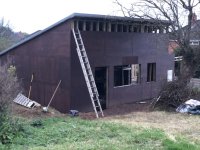

The next week should have the last of the front panelling put into place, and hopefully the house wrap will have arrived and can start making the exterior walls and openings waterproof. Also some more of the concrete block work needs finished off. Plenty to keep me busy.
Next up was to tackle the roof. The 8'x4' ply boards are heavy enough to lug around at the best of time, but to start hauling them up onto the roof was enough to make even Popeye loose hope. One small thing in my favour was the fact that the back was so much lower than the front, so was able to just about lean the boards on the edge and push up onto the roof, then drag into position. Once up and fixed, it was time to tape the joints to help make it watertight before the roofing felt goes on.
Nine rolls of felt was needed to cover this section of roof, all glued down with bitumen tar and tacked into place. This was done over several days, as the boards needed to be dry, so it was a case of looking at the local weather on our phones and working out when best to tackle the next section. This was a joint job between the wife and myself. Many hands and all that.
The rear of the building, lowest side, has a drip overhang to allow the addition of guttering, which will eventually move the rainwater into a soak away in the garden.
Was so glad when this was finished as it now gives me a dry location to work from if needed.
With the clocks now going back and the nights getting a lot earlier, it was time, see what I did there, to get the electrics in. First up was the lighting. Ordered four 5 foot batten lights, that can be set to 3 different lighting tones. Interesting to see these in action, so let there be light.
The next week should have the last of the front panelling put into place, and hopefully the house wrap will have arrived and can start making the exterior walls and openings waterproof. Also some more of the concrete block work needs finished off. Plenty to keep me busy.
Again we had a few good days, which makes a change, and the temperature is still in mid teens so managed to get a bit more work done on the workshop.
Last time I still had to finish off the front panelling, which has now been completed and waiting for the moisture barrier to arrive, which it did, just in time for the weekend. This is a Tyvek housewrap that I'm using, and you see it on a lot of building programmes, especially in the U.S.
I ended up buying 100 metres of the stuff, which is all on one roll, and weighs a fair amount. The first and second rows went on without a hitch, but the third one we needed to be a bit more creative, with it being so much higher. In the end we threaded a rope through the middle of the tube and a stopper on the end. My wife then got up onto the roof and dropped the housewrap down the side so I could tack it down, and we progressed around the outside, unrolling a section at a time.

In the end the workshop was all wrapped up for Christmas.
That's it for now, as this took quite a long time to get done.
This weekend, I'm hoping to get the window and door frames added, along with some temporary windows, and hopefully get the last of the block work out of the way. I may even try and start levelling off the floor in preparation for the concrete going in.
Last time I still had to finish off the front panelling, which has now been completed and waiting for the moisture barrier to arrive, which it did, just in time for the weekend. This is a Tyvek housewrap that I'm using, and you see it on a lot of building programmes, especially in the U.S.
I ended up buying 100 metres of the stuff, which is all on one roll, and weighs a fair amount. The first and second rows went on without a hitch, but the third one we needed to be a bit more creative, with it being so much higher. In the end we threaded a rope through the middle of the tube and a stopper on the end. My wife then got up onto the roof and dropped the housewrap down the side so I could tack it down, and we progressed around the outside, unrolling a section at a time.
In the end the workshop was all wrapped up for Christmas.
That's it for now, as this took quite a long time to get done.
This weekend, I'm hoping to get the window and door frames added, along with some temporary windows, and hopefully get the last of the block work out of the way. I may even try and start levelling off the floor in preparation for the concrete going in.
Another wee update from yours truly.
So with the exterior walls now covered with wrap it was time to look at the windows, doors and internals.
The window areas were cut out of the wrap, and I used one of the leftover beams to create a window sill. These are 9" x 3" and chunky enough for the look I was after. I created a slope to allow the water to run off and a drip channel underneath to help prevent the water being blown back up on the underside. Used scraps of wood then to make the outer framing for the windows and doors, giving them a good lick of sealer and wax paint to finish. This was now starting to looking like something.
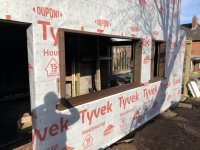

I'm not getting proper windows installed yet, but will put just sheets of plastic for now. I did get prices for these, so will probably add these sometime at the start of the new year.
So next up is the internal floor. This needs levelled off, a dust layer, damp proofing, concrete, insulation, and flooring. There are basically 2 ways of doing this. Put the insulation down first and concrete over the top of it, or lay the concrete first and insulate over that. The first is more suitable for a house where the concrete acts as a large storage unit, trapping heat during the day and releasing it at night. The second option allows for the rapid heating of the area due to the insulation being on top. Since we will more than likely be working in the workshop during the day and at home during night the second option is the obvious one.


So extra hardcore stone was added to level off the ground, next the dust went down and a whacker plate used to embed the dust between the stone and compact everything down. The Foreman obviously had to come in and check everything was up to his standard. The quarry dust also helps to prevent any sharp stones from puncturing the damp proof membrane.
Once complete it was time for concreting. Last time I use a concrete company and hired a pump for the foundations. This was a very expensive option, but the job was done really quickly. This time I decided to do the flooring and mixing of concrete myself, saving at least £2,000. Running at 4" in depth and given the size of the flooring, this was going to be done over a number of days as can be seen from the photos below.


After several tonnes of sand and stone, and 44 bags of cement, the floor area was finally finished, and looked well. Have to let the concrete harden, but next will be laying the insulation board, taping up and then the final floorboards can be put down.
So with the exterior walls now covered with wrap it was time to look at the windows, doors and internals.
The window areas were cut out of the wrap, and I used one of the leftover beams to create a window sill. These are 9" x 3" and chunky enough for the look I was after. I created a slope to allow the water to run off and a drip channel underneath to help prevent the water being blown back up on the underside. Used scraps of wood then to make the outer framing for the windows and doors, giving them a good lick of sealer and wax paint to finish. This was now starting to looking like something.
I'm not getting proper windows installed yet, but will put just sheets of plastic for now. I did get prices for these, so will probably add these sometime at the start of the new year.
So next up is the internal floor. This needs levelled off, a dust layer, damp proofing, concrete, insulation, and flooring. There are basically 2 ways of doing this. Put the insulation down first and concrete over the top of it, or lay the concrete first and insulate over that. The first is more suitable for a house where the concrete acts as a large storage unit, trapping heat during the day and releasing it at night. The second option allows for the rapid heating of the area due to the insulation being on top. Since we will more than likely be working in the workshop during the day and at home during night the second option is the obvious one.
So extra hardcore stone was added to level off the ground, next the dust went down and a whacker plate used to embed the dust between the stone and compact everything down. The Foreman obviously had to come in and check everything was up to his standard. The quarry dust also helps to prevent any sharp stones from puncturing the damp proof membrane.
Once complete it was time for concreting. Last time I use a concrete company and hired a pump for the foundations. This was a very expensive option, but the job was done really quickly. This time I decided to do the flooring and mixing of concrete myself, saving at least £2,000. Running at 4" in depth and given the size of the flooring, this was going to be done over a number of days as can be seen from the photos below.
After several tonnes of sand and stone, and 44 bags of cement, the floor area was finally finished, and looked well. Have to let the concrete harden, but next will be laying the insulation board, taping up and then the final floorboards can be put down.
Looks amazing! I can't wait to see if packed to the rafters with cabs.
You were saying! It's getting there.
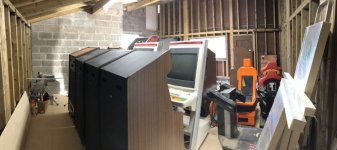
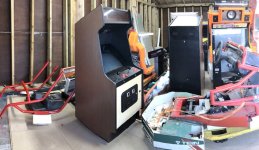
Have been down with the cold, but getting better, and as such, time for what was done last weekend. As you can see from the last post, there are cabs in the workshop. Oh dear!
Had given the concrete some time to go off and harden. It created an awful lot of condensation in the workshop. The underside of the roof, rafters, beams and walls were dripping in it, unreal, but after a coupe of days it all started to dry up and looked well again.
Time to get that all important floor insulation down. This is Kingspan PIR board which is foil backed on both sides. Simply drop, or cut and drop into place and do the seems with foil tape, helping to keep the boards in one place.


The good wife, always looking to give a hand, and tell me what to do 😊.
This went down really quickly, so finally, at least for now, the flooring. This was simply 22mm tongue and groove chipboard. You can get cheaper 18mm boards, but for this being a workshop, I was looking something a bit heavier. It's also fairly easy to cut, as long as the saw is sharp.

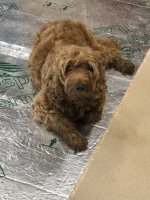
Once again, the foreman had to come in and check that the boards were being glued up correctly with expanding foam glue to help fill in the gaps and staggered. Again with the boards being fairly long, this process went quite quickly as well. The glue was hard in 24 hours so can walk on the next day. This meant that I could get the van hired and start moving the cabs from storage into the workshop and stop me paying those maddeningly high fees, at least here in Belfast that is.
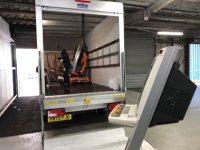

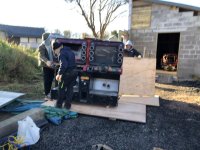
Amazingly this all went without too much of a hitch. The Midnight Maximum Tune twin racer is a beast of a machine to shift, but nothing compared to the SEGA Championship 2 DLX, when it doesn't have any useable wheels on the underside and all that metal just weighs a ton.
Oh! I'm looking the screen box section for one of these if anyone knows of one going.
I did have one wee pain point when shifting everything. On our second run, the trolley wasn't fastened down and decided all on its own to take out my B/W Invaders screen. Totally necked as can be seen.


Even though it's totally destroyed, I've got an idea for this. Another wee project starts its inaugural light in my mind.
So what's next! I'll have to get the front door made and locks and handle fitted. For now I'll just board out the connecting door between this part of the workshop and the main workshop area for now. I'll start to tackle that when the warmer weather moves in.
In the meantime, I've to go get an initial 16 sheets of insulation to start boarding out the walls and sound proofing for between the rafters and also to start looking at how I'm going to get the electrics wired up. I've also bought a high output oil burner to heat the place, but needs a good service.
Plenty to keep me busy, never mind trying to get the mini cab built. Tons of ideas for that one and I'll keep you all posted.
Incase any of you are wondering, these are all project cabs. Nothing here has been tested or presumed to be working. I've a load more in other locations, so over time I'll get those shifted here as well.
Had given the concrete some time to go off and harden. It created an awful lot of condensation in the workshop. The underside of the roof, rafters, beams and walls were dripping in it, unreal, but after a coupe of days it all started to dry up and looked well again.
Time to get that all important floor insulation down. This is Kingspan PIR board which is foil backed on both sides. Simply drop, or cut and drop into place and do the seems with foil tape, helping to keep the boards in one place.
The good wife, always looking to give a hand, and tell me what to do 😊.
This went down really quickly, so finally, at least for now, the flooring. This was simply 22mm tongue and groove chipboard. You can get cheaper 18mm boards, but for this being a workshop, I was looking something a bit heavier. It's also fairly easy to cut, as long as the saw is sharp.
Once again, the foreman had to come in and check that the boards were being glued up correctly with expanding foam glue to help fill in the gaps and staggered. Again with the boards being fairly long, this process went quite quickly as well. The glue was hard in 24 hours so can walk on the next day. This meant that I could get the van hired and start moving the cabs from storage into the workshop and stop me paying those maddeningly high fees, at least here in Belfast that is.
Amazingly this all went without too much of a hitch. The Midnight Maximum Tune twin racer is a beast of a machine to shift, but nothing compared to the SEGA Championship 2 DLX, when it doesn't have any useable wheels on the underside and all that metal just weighs a ton.
Oh! I'm looking the screen box section for one of these if anyone knows of one going.
I did have one wee pain point when shifting everything. On our second run, the trolley wasn't fastened down and decided all on its own to take out my B/W Invaders screen. Totally necked as can be seen.
Even though it's totally destroyed, I've got an idea for this. Another wee project starts its inaugural light in my mind.
So what's next! I'll have to get the front door made and locks and handle fitted. For now I'll just board out the connecting door between this part of the workshop and the main workshop area for now. I'll start to tackle that when the warmer weather moves in.
In the meantime, I've to go get an initial 16 sheets of insulation to start boarding out the walls and sound proofing for between the rafters and also to start looking at how I'm going to get the electrics wired up. I've also bought a high output oil burner to heat the place, but needs a good service.
Plenty to keep me busy, never mind trying to get the mini cab built. Tons of ideas for that one and I'll keep you all posted.
Incase any of you are wondering, these are all project cabs. Nothing here has been tested or presumed to be working. I've a load more in other locations, so over time I'll get those shifted here as well.
Last edited:
Haven't update this in an age, though the second half still looks the same. About to order some quarry dust to get stuck in again.
So here we go again.
After what seems an age with family and health issues, yet again, I'm starting the second half of the workshop, YAY!
This section hasn't been touched in a year and a half, and it's surprising just how quickly nature can take over. It was like a jungle out there, so first thing was to clear the area. Pity I didn't take any photos of before I started, but let's just say, it was a lot.
One advantage of it sitting for all this time, is it's had a chance to bed itself firmly into the ground, still it took a ton of stone and quarry dust to bring it back up to level. Then the whole area was compacted with the Whacker plate. Some sand to help fill in the spaces and whack the shit out of it again, until a good solid hardcore base was formed.
You can see the two doors on the far wall. The smaller is to the store, and the larger is for access to the clean workshop area. Made this bigger to make it easier moving cabs from the dirty side for all the construction work to the clean side for the detailing and electronic work, etc.

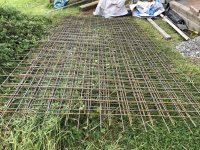
Next up was to get the damp proof membrane down, layout some of the insulation boards, and the concrete rebar mesh to help give it strength.
I wanted to get the guy with the pump again that I used when laying the foundations, and order in the concrete, but the prices for concrete pump hire has shot right up and just can't get myself around to paying out that sort of money, so it's going to be done on the old concrete mixer and in sections, which was the way the other half was done.
This is going to take a bit of time, and only when the weather permits, but hopefully not too long.
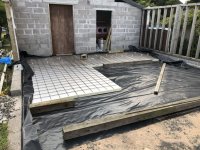
After what seems an age with family and health issues, yet again, I'm starting the second half of the workshop, YAY!
This section hasn't been touched in a year and a half, and it's surprising just how quickly nature can take over. It was like a jungle out there, so first thing was to clear the area. Pity I didn't take any photos of before I started, but let's just say, it was a lot.
One advantage of it sitting for all this time, is it's had a chance to bed itself firmly into the ground, still it took a ton of stone and quarry dust to bring it back up to level. Then the whole area was compacted with the Whacker plate. Some sand to help fill in the spaces and whack the shit out of it again, until a good solid hardcore base was formed.
You can see the two doors on the far wall. The smaller is to the store, and the larger is for access to the clean workshop area. Made this bigger to make it easier moving cabs from the dirty side for all the construction work to the clean side for the detailing and electronic work, etc.
Next up was to get the damp proof membrane down, layout some of the insulation boards, and the concrete rebar mesh to help give it strength.
I wanted to get the guy with the pump again that I used when laying the foundations, and order in the concrete, but the prices for concrete pump hire has shot right up and just can't get myself around to paying out that sort of money, so it's going to be done on the old concrete mixer and in sections, which was the way the other half was done.
This is going to take a bit of time, and only when the weather permits, but hopefully not too long.

Nice to get back to large projects, hope you get a chance to crack on
Missed this, nice work dude
When's the Opening Night
LOL. Let's just say, it's getting closer now.
So a fortnight and over 14 ton of concrete later, the dirty deed has finally been done, and I do mean dirty. The workshop floor is now complete.
This took way more effort than I had thought initially. Surprising just how quickly sand, stone and cement disappears.
So working this out, if I had ordered the concrete pre mixed and delivered, it was close to £2,500. The hiring of the concrete pump was £1,500, complete with operator, and a ground crew to help pour and flatten it out was £800. So total cost would have been around £4,800, but it would all have been done in a day.
Cheapskate me, didn't want to spend that amount of money on the floor so decided to do it all myself. Well managed to rope in the wife and son to help along the way. Total cost for everything was just under £1,500. A total saving of £3,300. Yes it was exhausting, and took nearly a fortnight, but at least it's now complete.

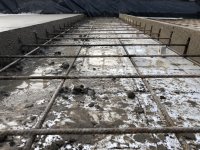
You can see in the above photo, the wooden framing I've used so I can do this in sections. The wood has slots cut into it to allow it to go over the concrete mesh. I've used tapered wooden standoff blocks to help in removing the framing once the concrete has sufficiently set.
The mesh uses concrete standoffs so it's raised above the floor insulation sheets and allows the concrete to flow all around it. The concrete is thick enough, almost 5 inches, so I can have a Luton style van drive into the workshop to help aiding in loading and offloading cabs
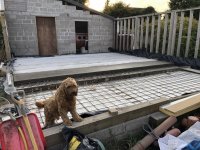
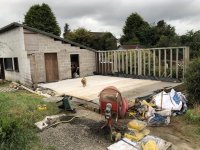
As usual the inspector was overseeing everything being done, and finally gave his paw of approval.
So next will be ordering in more 6x2 framing , 2 RSJ steel joists to hold the roof up and a load of 18mm plywood sheets for the sides and board out the roof. Plenty still to do, but slowly getting there.
This took way more effort than I had thought initially. Surprising just how quickly sand, stone and cement disappears.
So working this out, if I had ordered the concrete pre mixed and delivered, it was close to £2,500. The hiring of the concrete pump was £1,500, complete with operator, and a ground crew to help pour and flatten it out was £800. So total cost would have been around £4,800, but it would all have been done in a day.
Cheapskate me, didn't want to spend that amount of money on the floor so decided to do it all myself. Well managed to rope in the wife and son to help along the way. Total cost for everything was just under £1,500. A total saving of £3,300. Yes it was exhausting, and took nearly a fortnight, but at least it's now complete.
You can see in the above photo, the wooden framing I've used so I can do this in sections. The wood has slots cut into it to allow it to go over the concrete mesh. I've used tapered wooden standoff blocks to help in removing the framing once the concrete has sufficiently set.
The mesh uses concrete standoffs so it's raised above the floor insulation sheets and allows the concrete to flow all around it. The concrete is thick enough, almost 5 inches, so I can have a Luton style van drive into the workshop to help aiding in loading and offloading cabs
As usual the inspector was overseeing everything being done, and finally gave his paw of approval.
So next will be ordering in more 6x2 framing , 2 RSJ steel joists to hold the roof up and a load of 18mm plywood sheets for the sides and board out the roof. Plenty still to do, but slowly getting there.

K1ngarth3r
Active member
What a great space you'll have! Good to see some progress.